top of page


Sam Decker Blog


Career Tip #6: Inform Others
Inform your manager and peers about what’s going on. In 1x1s, in email, in staff meetings, make sure you are giving updates and status on projects, action items, and goals. If someone emails you something, respond back that it was received and when it will be done. Then email when it was done. It sounds simple, but this closed loop process builds confidence with your manager, his peers, and your colleagues.
Jan 14, 20071 min read


12 CEO (Leader) Diseases and Prescriptions
Dr. Robert Kuhn, who has 12 years experience in M&A and has worked with 15,000 companies and their CEOs, summarized 12 CEO Diseases and How to Treat Them. I’ve seen many of these diseases take hold of leaders I’ve worked for or with…and I have to fight off a few of these bugs as well. I’m posting it here because Chief Executive Magazine may not have a huge reach and I want to share these with a wider audience than just CEOs. These diseases should be guarded against among Gene
Jan 7, 20072 min read
How Measurement Leads to Money — 6 Steps
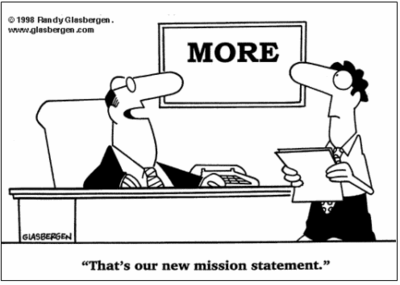
A mid-manager came up to me after a recent conference presentation and asked me how to convince his people – and even some executive management – why measurement was important. He was aiming to change the culture, and I applauded him for that. To get there he had to reach the intellect and the heart of people. Here’s how I suggested he might explain it… First get agreement that the mission is to ‘make more’… In all seriousness, business is a collection of policies, processes
May 23, 20062 min read
WHAT You Measure WHEN Determines HOW You Will Succeed
I just got back from presenting at Visual Sciences event on "How to Put eBusiness in the Heart of Your Business." I’ll share some articles on this topic later. The Keynote speaker was Tom Davenport, who wrote "Competing on Analytics", featured in Harvard Business Review and getting a lot of attention. The topic is timely. Tom and I spent some time discussing the organizational and strategic considerations for measurement. Here’s what I shared with him, although not in so many
May 6, 20065 min read


Three Questions: Change Leadership & Culture with Linda Ford
Such a consultant is Linda Ford, who shares a passion for culture and change leadership and has over 15 years of day-to-day management and training experience in Silicon Valley. The other day we had lunch and I asked her to answer three questions which you may find interesting. Check out Linda’s web site and blog. Few executives proactively consider culture in their day to day (sort of like unconscious parenting). Yet they affect culture in their day to day actions, and the e
Apr 17, 20063 min read
5 Findings on Change Management
Prosci’s Change Management learning center features a report titledBest Practices in Change Management. As summarized by Be Excellent, here are 5 important findings: The #1 contributor to (business improvement) project success is active, strong and visible sponsorship throughout the project. The top obstacles to successful change are employee resistance at all levels: front-line, middle managers, and senior managers and inadequate senior management sponsorship. Employees want
Mar 21, 20061 min read
25 Characteristics of The Ideal Startup
This is a list I created some time ago of the ideal startup… Defendable and differentiated Competitive cost structure Attractive partnership opportunities Repeat customers Word of mouth opportunity Memorable product and name Potential for PR Attractive to be bought or merged Scaleable staff and systems Scaleable product — build once, sell many times Uncomplicated Focus Niche market or fragmented industry High velocity and large market / industry High perceived value Product c
Dec 8, 20051 min read


Achieve Prioritization with Six Disciplines for Excellence
One of my favorite 'saved' books is Six Disciplines for Excellence by Gary Harpst. Here’s what differentiates this book: it bridges concept and principles to execution. The point Gary makes, as noted in the introduction, is that when it comes to achieving excellence, figuring out the right thing to do isn’t nearly as difficult as continuing to do them over the long term. Most books focus 80% on principles and 20% on implementation. This book is 80% implementation. Like most r
Sep 23, 20052 min read


How Culture is an “Atmosphere for Success”
Rick Barnes, prior Head Basketball Coach for the UT Longhorns men’s basketball team, spoke to my team once about leadership. Here are some of his principles: “Today a Peacock. Tomorrow a Feather Duster” – you always need to be improving to stay on top. And sometimes you fail…but you can come back. He hires people who weren’t “born on second base and thought they’ve hit a triple.” – people who have overcome hurdles appreciate where they are and work hard to stay there and imp
Sep 22, 20052 min read


The 3 Tributary Principles of Leadership
Take, for example, the recurring natural theme of tributaries and branching You see this in rivers, branches, our nervous system, our blood system, lung alveoli, and so forth. What are the common characteristics of Tributaries? TRIBUTARY PRINCIPLE: There is a solid foundation from which the depth, breadth and strength of the branches are determined. LEADERSHIP PARALLEL: Culture is driven from the top. The stronger the winning culture, the bigger, larger, wider, and more preve
Jul 5, 20051 min read


The #1 Key to Successful Partnerships
Through startups and Dell, I’ve worked hundreds of partnerships with suppliers and vendors. Many of them succeeded, and many failed. I’ve realized there is a primary reason when partnerships failed…Both sides had to change their processes / model The #1 Key to successful (read: profitable) partnerships is AT LEAST one side does not have to change their processes, business model, or sales model. If a vendor has a product they want to sell through your business, to your custom
May 30, 20051 min read
3 Innovation Quotes for March
One must be a god to be able to tell successes from failures without making a mistake. – Anton Pavlovich Chekhov There are two classes of people, those who do and those who take credit. My advice is to be a member of the first class; there is much less competition. -Dwight Morrow If you want to succeed, double your failure rate. – Thomas J. Watson
Mar 20, 20051 min read
How to Matter More
Everyone matters to someone…and if you can’t think of anyone, you matter to your mom! But you can choose to matter more. Here are some of...
Jan 2, 20052 min read

Voice of Customer Checklist
Is your company customer-centric? Have you unearthed customer needs. Do you hear the Voice of Customer? To find out, see how many customer interactions you have. This article on iSixSigma suggests the following checklist to see that you are increasing your customer interactions…and therefore improving the Is there sufficient time in your quality project planning phase (i.e. Define) to fully understand the customer requirements of your process? Are suppliers and subcontractors
Nov 28, 20041 min read


How “Functional Fluidity” Breaks
Every company has disparate functions, such as sales, accounting, marketing, etc. And in large companies there are similar functions in multiple divisions. It is the ability of these functions to work together, to communicate, to share best practices, or to move in the same direction that can result in exponential benefits to the company. Benefits such as cost savings, improved customer experience, and effective marketing, and employee satisfaction. Unfortunately, many functi
Sep 8, 20042 min read


First Break All the Rules: “Skills, Knowledge and Talents”
One of the best management books I’ve ever read is First Break All the Rules. With that kind of endorsement I’m hoping Marcus Buckingham won’t mind if I paraphrase one of the most important principles of the book. The differences between skills, knowledge and talents. This is not only profound for management, but everyday life and interactions… Skills, Knowledge, and Talents: What is the difference among the three? Great managers are not troubled by the fact that there is a
Jul 19, 20042 min read


"Get Back to Basics" -- Patrick Lencioni
Patrick Lencioni has been a friend of my father's for years. I got to know him many years ago too, and he honored me by answering a few questions. These are too good not to share with you… How do you uncover or spot management principles for your books? Observations, observation, observation. I am not a scientific researcher, in the classic sense of the word. I just observe the behaviors and trends around me, and try to make sense of them in a way that others can grasp.
Jul 10, 20043 min read


Cookbook for a Business Recovery
There's a revenue crisis. You need to do a business recovery. There are three choices: 1. Do nothing…i.e. keep on trucking, status quo. Keep the vision, things will get better, right? 2. Do something…i.e. pick something, likely without analysis, to do about it. Or put a plan together and and warm yourself with that blanket of paper. 3. Do everything….focus the entire business on the problem, analyze all potential root causes of the miss, choose a number of impactful activ
Jun 23, 20042 min read


10 Questions Before Business Planning
Entrepreneur posted an article called 7 Habits for Business Success by Brian Tracy, exerpted from his book “Million Dollar Habits”. There’s one section of the article I really like…it’s the first habit: Plan Thoroughly. It lists 10 questions for better business planning… Plan Thoroughly The first requirement for business success is the habit of planning. The better, more thoroughly, and more detailed that you plan your activities in advance, the faster and easier it will be f
Jun 16, 20042 min read


The Story of Rock and Sponge
Here’s what happened... Rock was a hard, seasoned pro. He threw weight into a problem and bulldozed through people to ‘make IT so’. “It” was what he thought to be right. He rarely asked questions…he believed he had the solid answers. While others tried to help him, their suggestions bounced right off him like a brick. It was as if his ears were filled with cement. It became clear to others that Rock was strong enough to do things himself. Others stopped weighing in their opin
Jun 14, 20042 min read
bottom of page